
We travelled China alone! You only need these tips

Updated: 16 minutes ago

China has been on my bucket list for ages, and frankly, I've been pushing it off because doing China alone seemed like a huge feat. But little did I know how wrong I was. If you're just as anxious as I was before my China trip to Beijing, Xi'an, Chongqing and Chengdu, here's everything you need to know to do China perfectly well alone (you don't need a tour group).
My husband and I decided to visit China in October and started planning about 2 months in advance. We returned from our 13-day visit last week, and I'm eager to share everything I learned and experienced along the way in all our following articles, so stay tuned.
China is not one of those spontaneous trips like Thailand. It's mandatory to have a plan, and we suggest starting 2 months before.
Verify Alipay and WeChat 1-2 weeks before your trip

We would say China is 90% cashless. Alipay and WeChat are pretty much the bread and butter over there. You want to buy a snack, a meal, a bus ride, a metro journey or a shuttle service, you NEED Alipay and WeChat both. Certain vendors don't accept Alipay. When we boarded the tourist bus for Grand Tang Mall (Datang Everbright City) in Xi'an, the bus required payment through WeChat. They refused AliPay.
However, these apps have high security that monitors unusual behaviour, which is why you need to set them up within the right time frame of your trip. 1 to 2 weeks is the sweet spot. Learn how to set up and verify your account without getting restricted in our next article.
You can do cash transactions for day-to-day stuff in China; however, it'll be a hassle, and if you don't have change, you may end up paying extra.
Set up Taobao, Pinduoduo and Meituan before you land (if you don't plan on buying a local SIM)
Our biggest regret was this. In China, you don't buy from malls or stores. All purchases are done on Taobao or Pinduoduo because it's cheap and convenient. Food and drinks are generally ordered on Meituan. If you walk into a Luckin Coffee, you can't simply place an order manually.

China is huge, and cities are huge too. You cannot physically visit every store; that's why online buying also makes sense for travellers like us on a timer.
Plus, these orders come within a day or two right to your hotel doorstep. My Rednote netizens mentioned this; however, we assumed we could do it while in China.
Neither of us bought a local SIM; we got eSIMs cause we wanted to stay connected to home with WhatsApp and Instagram, and we totally missed our chance. Without a SIM, you cannot set up a Taobao account, even if it's through Alipay.
So peeps, decide beforehand whether you will be buying a local SIM or not.
Learn Numbers in Chinese
We travelled China for 13 days with just Nihao and Xie Xie. You don't necessarily need to know the full language, but it's a great advantage to know the numbers because you'll be mostly buying stuff and negotiating stuff.
Our work around was the Calculator app, we'd show our desired number, and they'd try to match it.
As Mandarin has its own numericals, it's best to know at least up to 10 so that you can converse better with local vendors.
Get a Mainland China eSIM; don't buy VPNs

There are many eSIMs out there for travellers visiting China; I used Trip.com Mainland China eSIM and my husband bought a Billion Connect eSIM. Neither of us had any issues throughout the trip. Mine cost $13.33 for 30 GB for 15 Days. You can buy and add it one day before the trip.
If you're using Billion Connect, you can get 5$ off by using code: MXU42Z4P when signing up or checking out.
If you're using an iPhone, make sure to click Activate and, right before you fly, switch on Data Roaming. While you land in China, as it connects to the local signal, it'll activate on its own. You can surf the internet as you did before, make payments, etc. without a problem.
Do not buy VPNs, as they no longer bypass the Great Firewall.
Most Important China Travel Tip: Download Amap (You can learn it on the go)
Amap was our holy grail. You cannot survive China without Amap; I said it there. It's one of the most advanced applications I've come across. It's not just a map. It's a route guide and even connects to hotels, transfers, attractions, metro routes, etc. If you're lost, you can literally get it to show you the way through your camera.
It doesn't work when you're not in China; we were quite worried. But the moment we landed, it became our saviour. It worked well in all the cities apart from Xi'an; we had to cross-check with DeepSeek a couple of times to get the routes right. Especially the Terracotta Site route.
But all in all, a very important app to have.
A Translate App is crucial (Google Translate worked for us)
I believe this China travel tip doesn't need much explaining. With your eSIM, Google works perfectly fine, so keep your Google Translate app with Simplified Chinese at hand. Locals usually whip up their own translator when you reach out to them, but it's better to have yours as well.
Learn the Subway routes (saves loads of time)
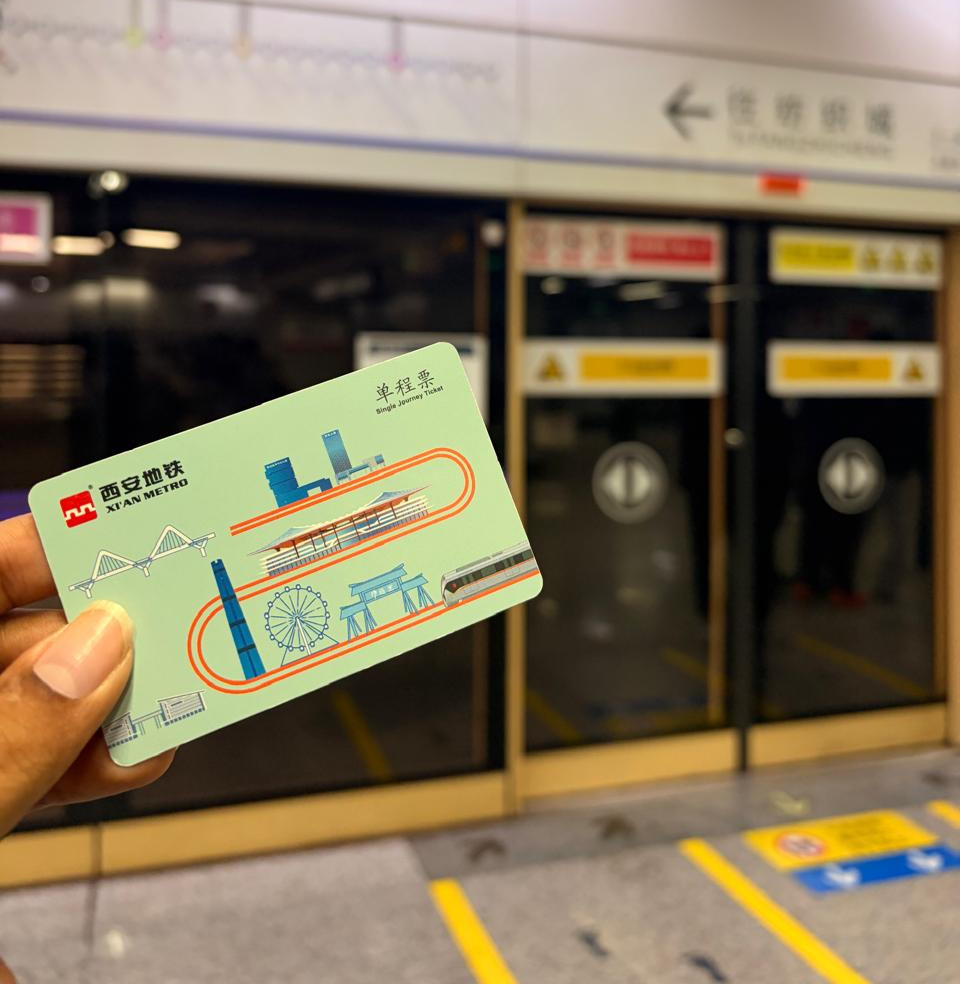
Getting around China is super easy if you go in the underground Subways. It's fast, and it's cheap. No road traffic and no waiting time. Amap will tell you exactly which ones to take to reach your end destination.
In Beijing and Xi'an, we collected our subway cards for every ride through the kiosk at the subway station; however, in Chongqing, the system is somewhat different, and they don't have physical metro cards. So we decided to activate the Chongqing Alipay Metro QR, and it has been super easy from there onwards.
Hygiene Wipes and Tissues are a necessity
You'll rarely find toilet paper in toilets, and there are no bidets. Surprising but true, for an Asian country to not have the glorious bidet, even in the hotel toilet, was a bummer. So carry wet wipes and tissues in your bag wherever you go.
Plus, most public toilets are squatting pans, not the European seat, so train yourself to do some squats before the trip.
Plan your Daily itinerary at least 2 weeks ahead (especially if you're riding high-speed trains)
You need to do tons of research for China, and it's very difficult to find non-promotional information on Google when it comes to China. If you're visiting the Forbidden City in Beijing, you need to book the ticket 7 days ahead. If you're taking the high-speed train from Beijing to Xi'an (super in-demand), make sure to book it 14 days ahead as soon as tickets are released on the 12306 China Railway Official website.

We booked on Trip.com 13 days ahead and already most of the First Class tickets were sold out. This is why you should plan your daily itinerary and routes at least 2 weeks ahead.
Avoid National Holidays
China's national holidays bring the crowds out from the hives onto the roads. Literally millions of locals flock to tourist sites, which means you lose the view and the photo opportunities. Chinese New Year, Mid-Autumn Festival, and October National Week (1-7) are among the key holidays to avoid religiously. The end of October and early November is the sweet spot for travel.
Book Key attraction tickets through Trip.com
Trip.com is slightly expensive but super reliable, plus it's the official ticket partner for the Emperor Qinshihuang Mausoleum and Panda Research Base. TikTok will tell you to buy from WeChat mini programmes, but these mini programmes are made for locals. If this is your first time, we encourage you to book both hotels and attraction tickets through Trip. We booked our Terracotta Site ticket and Panda Research Base tickets from here, and we had no problem.
As for the Forbidden City, we decided to book directly through their website as they urged, so the payment process was a bit complicated, but it finally did go through.
Keep your Passport with you all the time (It's your entrance ticket to everything)
When you purchase key entrance tickets, hotels and high-speed train tickets, you won't receive a physical ticket. Your passport is your ticket to pretty much everything. So make sure you put it in a Ziploc bag (if you're travelling during rainy season) and carry it with you wherever you go.
Buy a CCC power bank (Nothing else is allowed to be taken in)
China is pretty strict on power banks. Even to travel on the metro, you're not allowed to carry power banks that don't have the CCC mark (it doesn't matter even if it's faded; the rule is the rule).
Don't worry, it won't be a problem; We left our power banks at home and got one from a Miniso in Beijing. Lasted well for our 13-day trip, charging both our phones. It only cost us 70 RMB ($10).

Plus, there are portable power banks everywhere you go in China. On roadsides, restaurants, hotels and public places. We didn't try it, but you just need to sign in via Alipay or WeChat and rent the power bank hourly (ranging from 3-6 RMB -$1). However, there is a deposit involved.
Shop physically if you can get Tax-Free
Now that you have Taobao set up, all your tiny purchases can happen through the app. Big purchases can happen through official shops at malls with tax refund offerings. We shopped for a bunch of stuff at malls across China, from Uniqlo to DJI and were able to get our Tax Refund documents done.
In order to compile your tax documents, the store staff will need your passport. Once you receive the documents, keep them safe until your departure flight at the International Airport and get the documents validated by the customs officer, this needs to happen before the security check.

We transferred domestically to the International flight and bypassed the security check; however, due to the refund process requirement, we had to go back and return through security once again.
You're not supposed to use the purchased goods; however, our return journey was through Kunming, and the airport customs didn't inspect the goods. So we assume it's a case-by-case inspection.

Remember the airport codes you're flying to and from (not the name of the airport)
Our trip was smooth from the begining, that towards the end we felt quite suspicious, only to end it with a bang. Our flight back home was from Chengdu, and our flight was scheduled at CTU Airport; we assumed it was Chengdu Tianfu Airport. Travelled 1 hour to reach the airport, only to find out CTU stands for Chengdu Shuangliu Airport. Tianfu Airport is TFU. To tell you, the ride back home was super stressful. Luckily, we arrived early, so we had time for mishaps.
So please memorise the code names because the name of the airport sometimes doesn't match the acronym in China.
Don't wait till the last few days for Shopping

The choices are limitless when it comes to shopping in China. Similarly, what you find in Xi'an, you may never find in Chengdu. I mean everything literally. From seasonal fruits like Persimmons to Haircare items. I bought a Pate brand leave-on hair conditioner at a 24/7 mart in Beilin, Xi'an, on our last day there, and I wanted to buy a few more of it when we reached Chongqing, but couldn't find that specific product anywhere. Not even at the supermarket. The brand, yes; the product no.
So when you see something that you like, especially souvenirs in that city, make sure to buy them.
Supermarkets are located underground (ask your hotel for guidance)
For any last-minute shopping, Supermarkets in China are your saviour. Some are huge, like department stores. However, they're hard to find. Most of them are underground or in the basement of shopping malls. So ask your hotel staff to pin them for you on Amap.
Check for hotels with easily accessible Laundry Service
When you eat steaming hot and oily food with chopsticks, walk along streets with grilled meat vendors and spice shops, your hair and clothes acquire a smell that can only be washed off. You need to do laundry almost every day; this is why many hotels in China provide free laundry. The challenge we face, however, is the service, cause some hotels don't assist you.
We stayed at Ramada Bell Tower Hotel in Xi'an, and the laundry was available, but we had to do it on our own. There's no assistance, which means the 1 hour of washing and 30 minutes of drying is time out of your day. But it's open 24 hours.
On the other hand, our hotel in Chongqing, the Move River View Hotel, did our laundry. We had to hand it over before 8 p.m., and they'd keep it ready by 7 a.m. the next day.
Don't hesitate to ask locals for help
Chinese people are very hospitable, though they come off as loud and rude at first. They won't initiate conversations with you, but they'll curiously stare at you. If you reach out for help, they'll be ready with their translator apps to help you out. So if you're struggling with something, don't hesitate to ask for help.
Save your hotel's exact Chinese name and the address
Unless you're staying at a Ritz-Carlton, a Hilton or a similar international franchise, every other Chinese hotel has a Chinese name, and the English name is just for the sake of it. Drivers and locals don't know the English name, and sometimes there are multiple hotels with branches in the same area, with the same English name.
Don't spend too much on Hotels. They all look and serve alike
If you're a traveller who'll mostly be out throughout the day, don't spend too much on hotels. Chinese hotels on Trip.com all offer pretty much the same amenities. You can book a good Chinese hotel for 3 nights under 100$ that offers the same service as a big chain would offer. However, do look for rooms that are 25 sqm or bigger, have windows and preferably non-smoking.
More importantly, get a hotel that's just a few meters away from a subway station. Trust us, makes life much easier.
Don't forget to fill out the Arrival Card
Every traveller entering China is required to fill out the arrival card before the Immigration check. It's an application form requesting your information, where you'll be staying and when you'll be flying out. It'll take about 10 minutes because you're supposed to enter the name and address of your hotel, etc. Usually, the airport ticket boarding counter informs you and provides the QR code; it's best to submit it before your flight. It's valid upto 72 days.
If you're running late, Here's the link to fill it: https://s.nia.gov.cn/ArrivalCardFillingPC/entry-registation-home
Before winding up;

This article is just an overview of tips from our 13-day trip to Beijing, Xi'an, Chongqing and Chengdu. In our upcoming articles, we will share our full experience in each city so you're prepared for your trip.
Stay tuned! Super excited!
In the meantime, if you do have any questions, drop them in the comments below.


Comments